
Professor Olaf Diegel
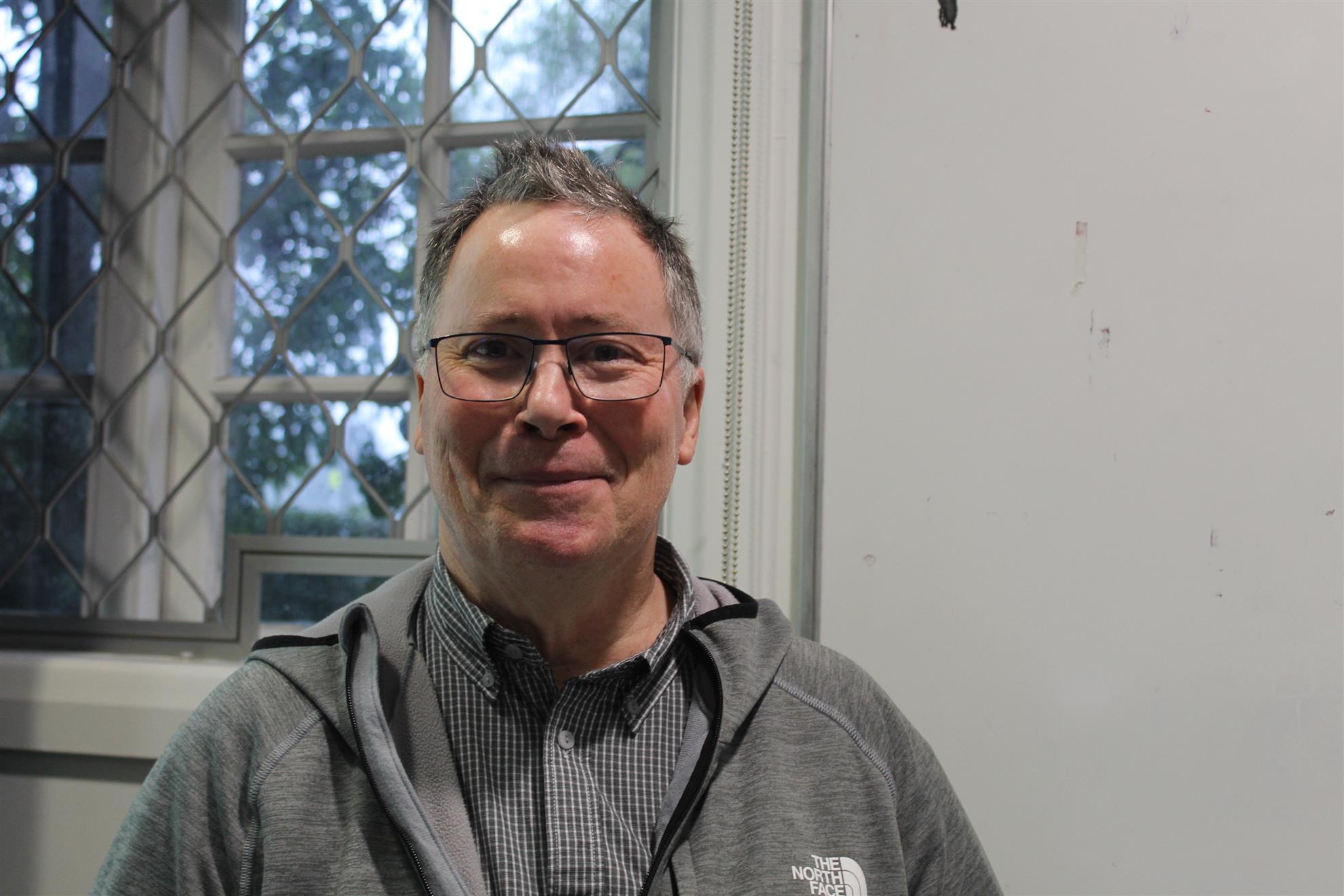
Our speaker on Tuesday was Professor Olaf Diegel a Professor in Auckland University's Faculty of Engineering and Design, Mechanical & Mechatronics Engineering where he heads up the Creative Design and Additive Manufacturing Lab at the University of Auckland.
Introducing Olaf Brian McMath noted that Olaf has been involved in Additive manufacturing and 3d printing in New Zealand since 2013. His efforts led to the formation of a project accelerator that still exists today. He has hosted students from the Summer Science forum at the University of Auckland, providing lectures and demonstrations.
Oliver's role in the Faculty includes entrepreneurial academic activities and advanced 3D printing updates.
Olaf in his address explained the difference between subtractive manufacturing and additive manufacturing, emphasizing the latter's high precision and cost. He provided an industrial example of weight-saving through 3D printing, highlighting significant cost and fuel savings.
He told us of the barriers to innovation in traditional manufacturing and how 3D printing can overcome them.
Having set the scene Olaf moved onto examples of 3D Printing in Product Development
He shared a case study of a student, Jenna, a competitive cyclist who used 3D printing to create clip-on wheels for her bicycle box so it could be easily moved around airports. The 3D printing process allowed Jenna to quickly prototype and sell her product, demonstrating the technology's rapid prototyping capabilities.
Olad spoke of the challenges of creating 3D models before 3D printing and the recent advancements in AI-generated parts. He gave us examples of AI-generated images and the limitations of current AI capabilities in creating functional 3D models.
Since 2013 3D printing technology has advanced significantly. But there are still limitations in current AI-generated models, such as the need for detailed engineering information when creating a design. Olaf introduced us to computational design, which aims to automate the design process for 3D printing.
He gave us examples of computational design projects, including a ship latch generator and an automatic earring generator.
Medical Applications. Olaf showed us how 3D printing is used to create custom prosthetics, using scans of the residual limb to create perfectly fitting sockets. He shared a real-world examples including that of a kayaker who benefited from a custom-made prosthetic with a better wrist joint. He showed us how the use of 3D printing can create comfortable casts and splints, which can be tailored to individual needs.
Having spoken about the medical and commercial applications of 3D printing Olaf told us about his personal projects, including 3D printing guitars with complex geometries. He showed us an example of a steampunk guitar that was printed as a single piece, with moving gears and pistons. Olaf showed us a guitar made from wood powder and bio epoxy, highlighting the potential of 3D printing with sustainable materials.
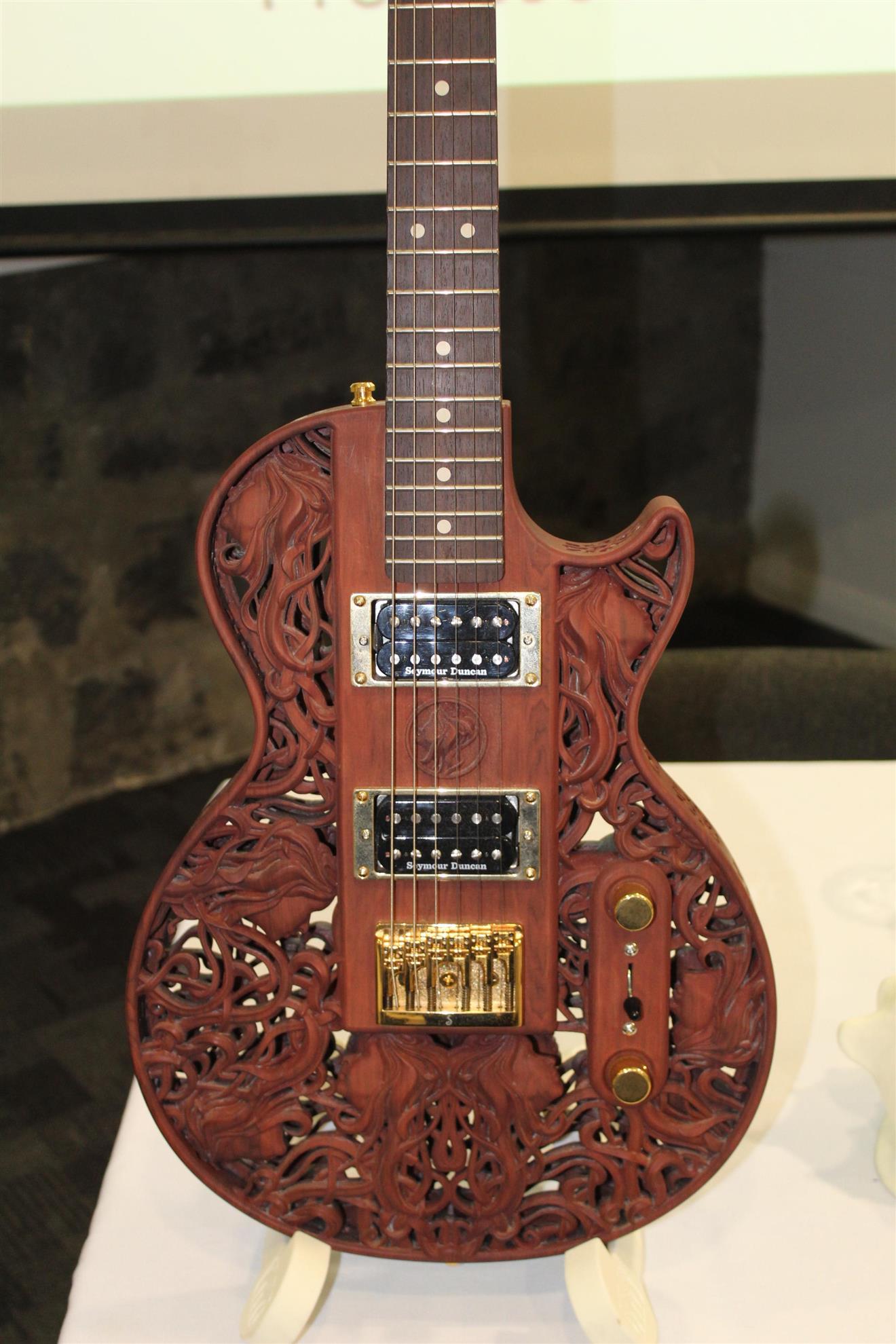
Olaf talked about cultural preservation projects he has engaged in, such as replicating a conch shell trumpet using medical imaging and 3D printing. He is working with Ngati Whatua in relation to cultural preservation, including reproducing ancient wooden instruments from shavings.
His latest project is printing a sugar skull-themed guitar for a client in America, which in turn show-cased the intricate detailing possible with 3D printing.
During question time, of which there were many Olaf discussed the development of 3D printed heart valves for children with rheumatic heart disease, which grow with the child to avoid repeated surgeries. There are two methods -bio-printing using stem cells, which grows with the body and reduces rejection risk, and a mechanical valve that expands as the child grows. The bio-printed valve is considered more attractive but also more complex, while the mechanical valve is simpler but still effective. The focus is reducing the need for frequent surgeries in children, as adults do not face the same issue.
Olaf explained the various materials used in 3D printing, including wood, metal, plastic, ceramics, and human tissue. He told us that different printers are required for each material, with technologies divided into powder-based, solid material, and liquid material categories. This led into a discussion about concrete printing for housing, leading to a discussion on the challenges and advancements in this field.
Olaf described the use of 3D printing for housing as being similar to layering concrete like icing on a cake. He noted that a company, Clorox, has built an architectural house and a children's daycare center using 3D printing. The process involves printing only the walls, with traditional methods still used for insulation, electrics, and windows.
The biggest challenge faced by companies like Clorox in New Zealand, include regulatory hurdles and building standards. Despite proving the performance of their concrete, they face difficulties in meeting traditional building standards. Indeed the biggest challenge is not the technology but the regulatory barriers, which are more complex than the printing process itself.
Lastly, there was discussion about scalability and cost of 3D Printing Materials. There are varying print sizes available, with the largest being 600 by 600 by 600 millimeters, but most are smaller. Concrete printers can move along with the printing process, similar to a tractor, allowing for large-scale printing. The cost of 3D printing materials is high which is a significant barrier, but as the scale of production grows, prices are expected to come down.
Olaf brought a few items that had been produced using 3D printing which were circulated around the room. These showed the possibilities for 3d Printing is only constrained by one's imagination.