
Chris Print - Vocational
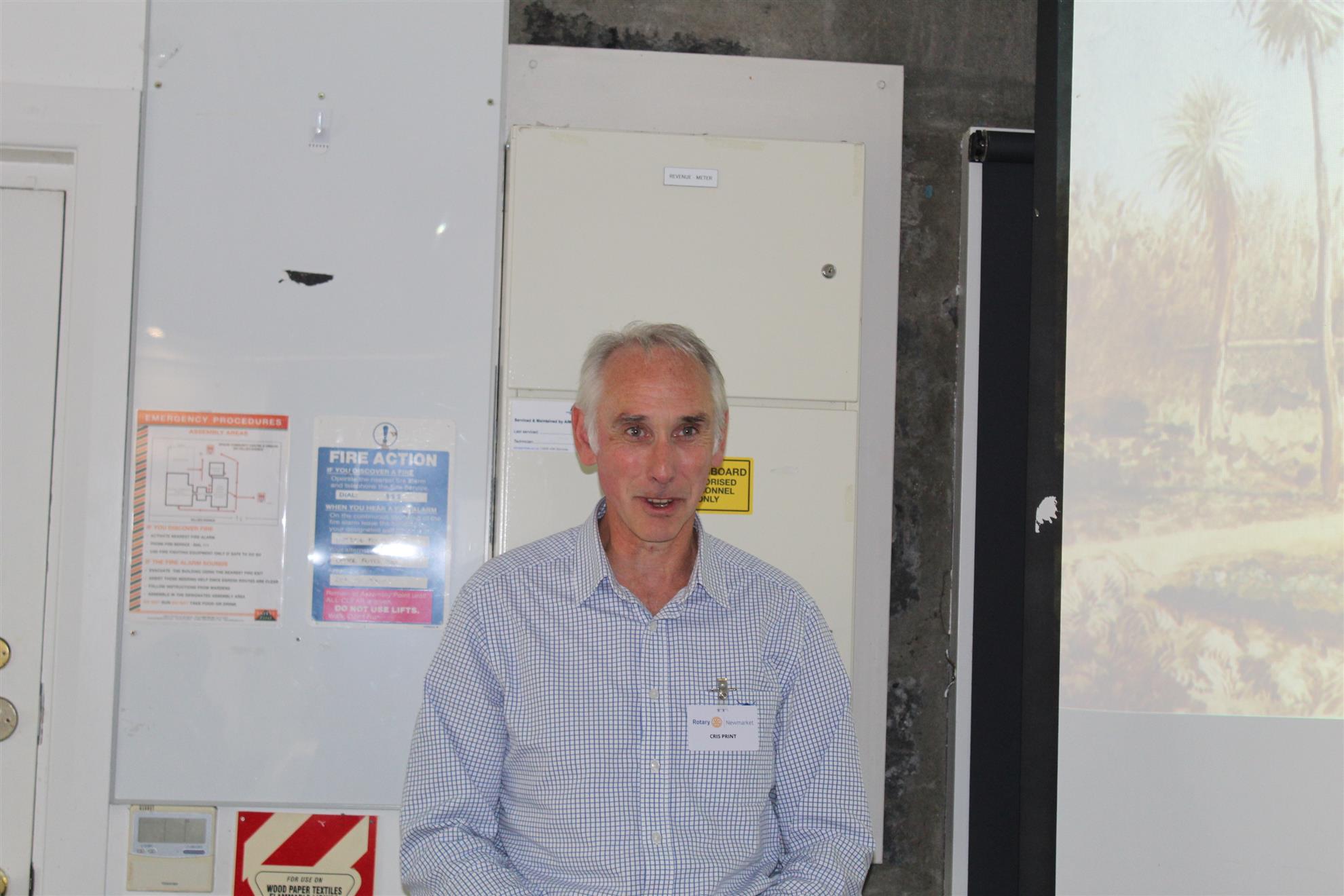
Our Newest Member Chris Print gave us his vocational on 31 March 2026.
As is always the case Chris's vocational showed what a diverse and extra-ordinary membership we have.
His vocational is sumarised below.
Chris told us of his background, mentioning his birth in the Manawatu and the history of his great-grandfather's land, which was acquired at gunpoint.
He attended King's College, where he struggled academically due to dyslexia but was supported by dedicated teachers, particularly a biology teacher who introduced him to science. His passion for science led him to medical school. Outside of medical school, he sailed, and raced Javelins competitively. During this period he met his wife, Adele, and later served in the New Zealand Army and special services in the UK.
Chris spoke of his transition from the military to medicine, driven by a mountaineering accident that ended his plans for a military career.
He became passionate about medicine and research, working with surgeon Jim Shaw on a research project that sparked his interest in changing the future of medicine. In Dunedin, he conducted a large research program on asthma and later worked with Jim Watson and Jeff Christmas at Genesis, New Zealand's first biotech company.
He was involved in the human genome project, cloning a human gene named CG1, and worked as a postdoctoral fellow in Melbourne.
Chris then moved to Cambridge, UK, as a fellow at St Edmunds College, where he worked and subsequently founded a biotech company using deep biological knowledge and Bayesian statistics. The company, initially based in Delaware for tax reasons, later moved to Japan and successfully helped drug companies fail drugs early in the pipeline. Despite some financial issues the company went public just before the 2000 dot-com crash, allowing the team to take an exit. Chris then returned to New Zealand, focusing on combining traditional clinical acumen with genomics and mathematics to make a difference in patient care.
During the Covid-19 pandemic, Chris served as a director and later as chair of ESR, contributing to the sequencing and analysis of the covid virus. Chris emphasised the importance of information in fighting pandemics and the need for better preparedness. Chris is involved with the Auckland Regional Biobank, which collects tissues for research with ethical approval and consent.
Going forward, Chris talked about his work with Kea, a New Zealand organization that links New Zealanders to companies and academics overseas. He highlighted the importance of networking and collaboration, particularly with young scientists and businessmen. His research continues to focus on precision medicine, using augmented reality to better understand individual patients, especially those with cancer. In particular he mentioned work being undertaken in relation to cloning a human gene using radioactive DNA and acrylamide, and the advancements in cancer research over the past 30 years. Chris went on to share an example of a patient with 40 metastatic tumors, where comprehensive analysis and AI/augmented reality technology were used to map the evolution of the cancer.
This work underscores the potential for future advancements in cancer research and the importance of continuous innovation.
Chris concluded by expressing his excitement for the future of medical research and the impact it will have on improving patient care.
All we can say is welcome to the club Chris.