

Professor Julian Patton and Land Rover No 20
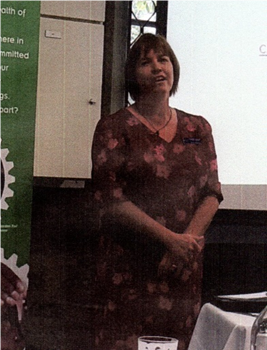
Peter Ross introduced Professor Julian Patton, a leading cardiovascular scientist from New Zealand to guests at the meeting.
Julian is currently undertaking an epic road trip across New Zealand in an old Land Rover to raise awareness and funds for heart research.
He was a headline act at Parliament and is being celebrated for his contributions to heart health research.
Before Julian addressed us Peter Ross told us about the John and Anne Burton Heart Research Award which is a partnership between our club and the medical school to support emerging researchers. The award aims to improve heart health for future generations. John and Anne were thanked for their contributions to the award.
Before starting his formal address, Julian announced the first awardee of the John and Anne Burton Heart Research Award - Sryana Sukdev. Julian gave us a summary of her research project at University College London where she is focusing on nitrite, which helps preserve brain cells during strokes. It appears that Nitrite protects mitochondria in the brain, preventing cell death and potentially leading to a recovery. Syrana's work is progressing so well that she is staying as long as she can in London to get as much work done as possible. We will be hearing from her in the new year when the award is presented to her.
Julian moved on to talk about another researcher Dr Olivia Gold. Olivia completed her PhD with no corrections, which is a rare achievement. Olivia has discovered a novel antidote against morphine-induced respiratory and blood pressure collapse that unlike those used at the moment does not block pain relief.
Olivia's discovery is significant as it could save lives in hospitals where morphine overdoses are common.
Julian then turned his attention to things Land Rovers and in particular the 20th Land Rover that rolled off the production line in 1948.
Julian's childhood seemed to involve Land Rovers of all models and states of repair. He told us the story of Land Rover 20 which was built in 1948 and is a significant piece of New Zealand's motor heritage. This is for the simple reason it was the first one landed in New Zealand.
Julian did mention that Land Rover 1 still exists and is in the hands of Sir Peter Ratcliff, one of the owners of Manchester United.
Julian's wife was initially skeptical of his intention to purchase the vehicle but later agreed to the purchase after learning its historical significance. The Land Rover was in good condition due to being stored in a garage for 30 years.
Julian decided to drive the Land Rover from Dunedin to Auckland as a charity run to raise funds for heart research. Jaguar Land Rover supported the initiative by offering dealership events and lending a new Defender for tools and spares.
The journey involved a journey of some 2200 kilometers on paved and unpaved roads, through creeks and through various mountain passes and off-road terrain. Julian and his neighbor, Craig Irwin, spent three months planning the route and preparing for the trip.
The trip was challenging. At the start, Julian faced a minor issue with the Land Rover's ignition system the night before departure, but managed to resolve it. The Land Rover performed well during the trip, despite its age and limited previous use.
The journey attracted attention from other Land Rover enthusiasts, who joined them along the way. As noted above the trip included crossing rivers and navigating challenging terrain, showcasing the Land Rover's inherent durability.
Where-ever Julian went a convoy of Land Rovers would materialise. Leaving Christchurch some 35 Land Rovers accompanied them. The whole journey was met with support and curiosity from the public, who were interested in the historic vehicle. Julian told us that he was impressed with the Land Rover's reliability, despite its age and condition.
Julian told us that the convoy traveled through stunning landscapes, including the Molesworth, where they camped.
The convoy visited a sheep farm called Namatia, where they learned about the history of number 20. Julian told us about the experience of driving through a farm with 22,000 ewes, which took all morning. He met with one of the sons of original owner of Land Rover 20 - Mr. Stewart Morrison in Taihape. Mr Jim Morrison was reunited with the Land Rover, feeling nostalgic and sharing stories about it.
While travelling, the convoy used an app to track their progress and receive support from the community. The convoy faced various challenges, including breaking a spring and finding a free repair shop. People along the way provided food, petrol, and other support, including a bakery in Geraldine selling heart-shaped biscuits.
Wherever they went the convoy encountered Land Rover enthusiasts who all offered assistance and support.
Julian told us that in anticipation of visiting Wellington he had written to his local MP Brooke van Velden, to request permission to drive number 20 up the steps of Parliament. Not unsurprising ly permission was not granted for that exercise but they were allowed to drive up to the steps and park near them. Julian was when they arrived at Parliament joined by David Seymour who attempted but was prevented from driving up the steps by Parliamentary Security.
Julian told us about the need for Land Rover 20 to have a rebore as its pistons and cylinders were shot leading to loss of power compression and oil buring. That segued neatly into a discussion about rheumatic heart disease, emphasizing its prevalence in New Zealand. He explained the function of heart valves and the impact of rheumatic heart disease on children.
Julian went on to describe current treatment options, including titanium and decellularized valves. Current treatment options involve the need regular surgery as patients grow out of the replacement valves so there is an incentive to identify other ways of creating heart valves. Julian then mentioned the concept of creating a living heart valve using stem cells and 3D printing. The process of creating a living heart valve involves taking MRI images, making a 3D print, and growing stem cells. The valve is tested in a pressure system to ensure it functions properly. The goal is to provide a single operation that avoids multiple surgeries and rejections.
Returning to Land Rover 20 Julian told us of meeting Sue Sweet, a survivor of one of the first cardiopulmonary bypass operations in New Zealand which was undertaken by Sir Brian Barrett-Boyes. In a clip played to the meeting Sue shared her experience of having valve operations and the impact on her life. That conversation highlighted the importance of raising funds for research and development.
Julian told us of progress of the research fundraising, noting they have raised $146,483 towards their $300,000 target. Julian takes pride in being the custodian of the most original Land Rover in New Zealand. He thanked the audience for their appreciation of his story and the work done by the Burton family in promoting heart research.


Come join us for a club meeting
Auckland, 1051
New Zealand